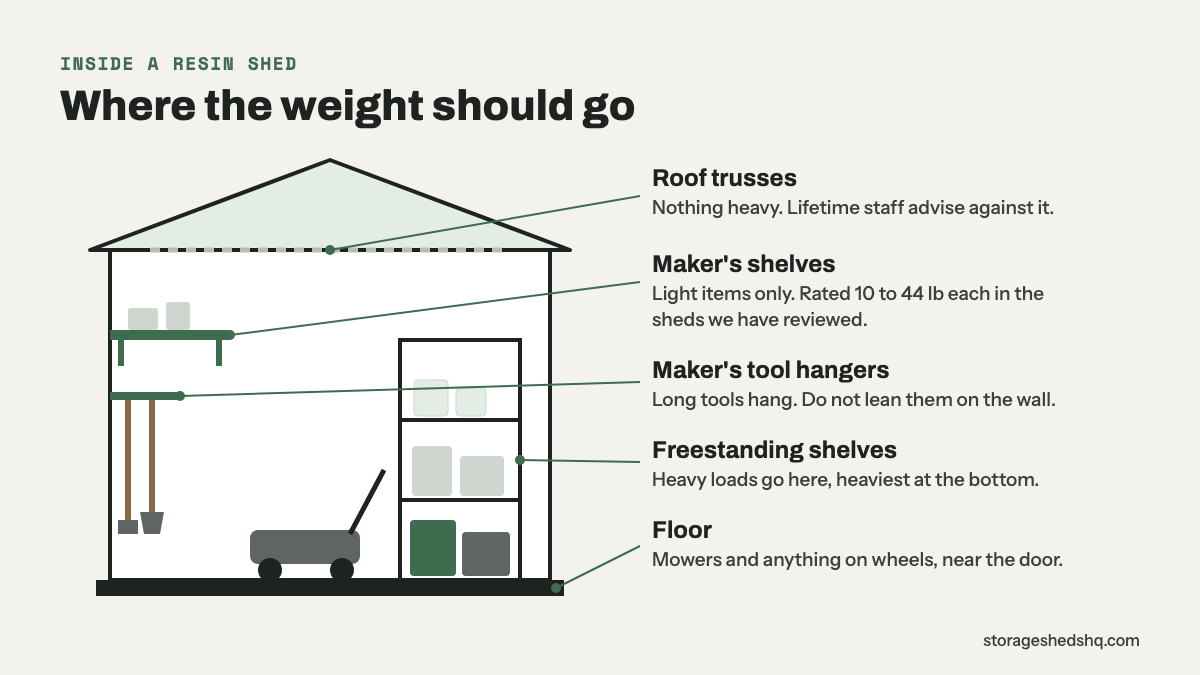
Most of the unused room in a shed is on the walls and above head height. In a resin shed, those are also the weakest places to put weight. Heavy things belong on the floor or on freestanding shelves. Light things go on the shelves and hangers the maker designed for the shed. This guide shows what each brand allows.
How we wrote this: this guide is based on manufacturer manuals, product pages and staff answers, as reported in our reviews of each shed and checked in October 2026. Each figure links to the review it comes from.
Key Takeaways
- Find out what your shed’s walls can hold before you hang anything. The makers differ.
- Use the shelves, brackets and peg strips made for your shed, and respect their weight ratings.
- Put heavy loads on freestanding shelves, with the heaviest items at the bottom.
- Do not lean heavy items against resin walls or hang them from the roof.
Start With What the Walls Can Hold
A wood-framed shed has studs you can screw into. A resin shed has hollow wall panels, and its maker decides what they can carry. Here is what the makers say about the sheds we have reviewed.
| Brand | What the maker says |
|---|---|
| Lifetime 60001 review | Staff say the shed was not designed to have heavy items hung from the walls or roof trusses. They recommend freestanding shelves for heavy items. |
| Suncast Tremont review | The manual warns against leaning heavy items on the walls, because that can distort the panels for good. Hang long tools on Suncast’s own hangers. |
| Keter Factor 6×3 review | The Factor 6×3 has brackets for shelves you cut from 3/4 inch wood planks. Each shelf is rated for up to 44 lb. |
| Rubbermaid 7×7 review | The Big Max comes with 12 adapters for shelving, pegboard and accessories. The 7×7 Storage Shed lists none. |
| DuraMax DuraMate review | The DuraMate’s wall columns have metal inside them, which DuraMax says makes it easy to hang shelves or garden tools. |
Owner reports point the same way. In our Keter Newton review, owners of the larger Newton sizes say the walls flex and are hard to fix shelves or hooks to. One owner says a wall bowed out after bikes were hung on it.
Use the Shelves That Came in the Box
Many sheds include shelves and peg strips. They are the safest way to use the walls, because they fit mounting points molded into the panels, but they are for light items.
| Shed | Included in the box |
|---|---|
| Lifetime 6411 | Five shelves and two pegboard strips |
| Lifetime 6433 | Seven shelves and two peg strips |
| Lifetime 6446 | Two long shelves, four corner shelves and two peg strips |
| Lifetime 60001 | One long shelf, four corner shelves and two peg strips |
| Lifetime 60057 | One 30 x 10 inch wall shelf and two corner shelves |
| Suncast Tremont 8×10 | Two adjustable corner shelves that fit any corner |
Where a manual gives a weight rating, it is low. Lifetime rates each shelf in the 6433 at 30 lb. In the 60057, the wall shelf holds up to 30 lb and each corner shelf up to 10 lb.
A 30 lb shelf is for hand tools, gloves and spray bottles. Paint cans, bags of soil and toolboxes add up fast, so weigh anything you are unsure about before it goes up.

Add the Maker’s Accessories Before You Drill
If your shed came with bare walls, look at the maker’s accessory list first. These parts are designed around the panels, so nothing has to be drilled.
- Suncast: a shelf kit (BMSASHELFK1) that fits the back wall only, a 2 ft resin shelf (V7572PK), baskets (BMSBSKT2PK), a long handle tool hanger (V724BLD) and a single tool hook (V742PK). These are listed for the Modernist 7×7 and the Tremont.
- Suncast vertical sheds: the BMS5700 has notches for up to three shelves, 16 inches apart. The shelves are sold separately. See our BMS5700 comparison.
- Keter: a 40 inch shelf kit, a wall tool organizer and a corner tool rack.
- Shelves you cut yourself: some sheds have molded brackets and leave the shelf to you. The Rubbermaid Large Horizontal Storage Shed shows how in its instructions: 3/4 inch lumber, about 53 3/8 inches long, with the back corners clipped.
Put Heavy Loads on Freestanding Shelves
Anything heavy belongs on a shelving unit that stands on the floor and carries its own load. That is what Lifetime staff recommend, and it is our advice for the Keter Newton too, given what its owners report about the walls.
- Measure the door opening and the wall height before you buy. A unit has to fit through the door, and low sheds have low walls.
- Stand the unit a little clear of the wall, so nothing leans on the panels.
- Load the heaviest items on the bottom shelf to keep the unit stable.
- Sort small items into lidded, labeled bins. A shelf holds more that way, and you can find things.
- Check that the shed floor sits on a level, solid base. Shelving rocks on a floor that is not flat.
Lay Out the Floor by How Often You Use Things
Floor space runs out first, so give it to the things that cannot go anywhere else: the mower, the wheelbarrow and anything else on wheels.
- Park wheeled equipment nearest the door, facing out.
- Keep a clear path from the door to the back wall. If you have to move three things to reach a fourth, the layout is wrong.
- Put things you use every week near the door, and seasonal gear at the back.
- Measure the mower at its widest point, deck included, against the door opening before you plan around it.
Door position changes the plan. The Lifetime 60001 has doors on two walls, so you can wheel a mower in through the end and still reach shelves through the side. The cost is less wall for shelves and hanging tools.
Hang Long Tools, and Keep Bikes on the Floor

Long-handled tools take the least room when they hang. In a wood-framed shed you can screw racks or battens into the studs, as in the photo above. In a resin shed, use the maker’s tool hangers or peg strips, and never lean a row of tools against the wall.
Bikes are different. Older advice, including an earlier version of this page, suggested hanging them from wall or ceiling hooks. In a resin shed that puts a heavy load exactly where Lifetime advises against it, and where a Newton owner reported a bowed wall. Stand bikes on the floor, in a floor rack if you have several. If bikes are the main thing you store, see our guide to the best bike sheds.
Keep It Working
Once a year, empty the floor, sweep out, and put back only what you used. Keep vents and skylights clear of stacked gear so the shed can air out. Clean and dry tools before they go back on the wall. Our guide to maintaining your garden tools covers that routine.
If you are still choosing a shed, the included shelves and the door position are worth as much attention as the footprint. Our storage shed buying guide covers sizing.
Shed Storage FAQs
Can I screw shelves into the walls of a resin shed?
Check with the maker first. Lifetime staff advise against hanging things on the walls of its sheds and recommend freestanding shelves for heavy items. Suncast and Keter sell shelf kits and hangers that fit their own wall panels, which avoids drilling.
How much weight can shed shelves hold?
It depends on the shed. In the sheds we have reviewed, the included shelves are rated from 10 lb for a small corner shelf to 44 lb for a shelf on Keter Factor 6×3 brackets. Lifetime rates the 6433’s shelves at 30 lb each.
Can I hang bikes from the roof of a plastic shed?
It is not a good idea. Lifetime staff say its sheds were not designed to have heavy items hung from the walls or roof trusses. Stand bikes on the floor or in a floor rack.
What is the best shelving for a plastic shed?
Use the maker’s shelves or shelf kit for light items, and a freestanding shelving unit for anything heavy. Measure the door opening and wall height before you buy a unit.